
Concrete Preparation for Epoxy Flooring
Before any coating bonds to a slab, the concrete itself has to be ready. Surface preparation is the foundational step in an epoxy floor installation, and it’s often a major factor in whether a coating performs well over the long term or develops problems like peeling.

The Short Answer
Concrete preparation for epoxy flooring typically involves three stages: mechanically opening the surface so the coating has something to grip, filling cracks and repairing surface defects, and testing for moisture. Together, those steps create the conditions the coating system needs to bond and perform. The contractor assesses the specific slab and determines what level of preparation is required before work begins.
The Three Essential Steps
Here is what professional concrete preparation generally involves, in the order it typically happens.
01
Cleaning & Grinding
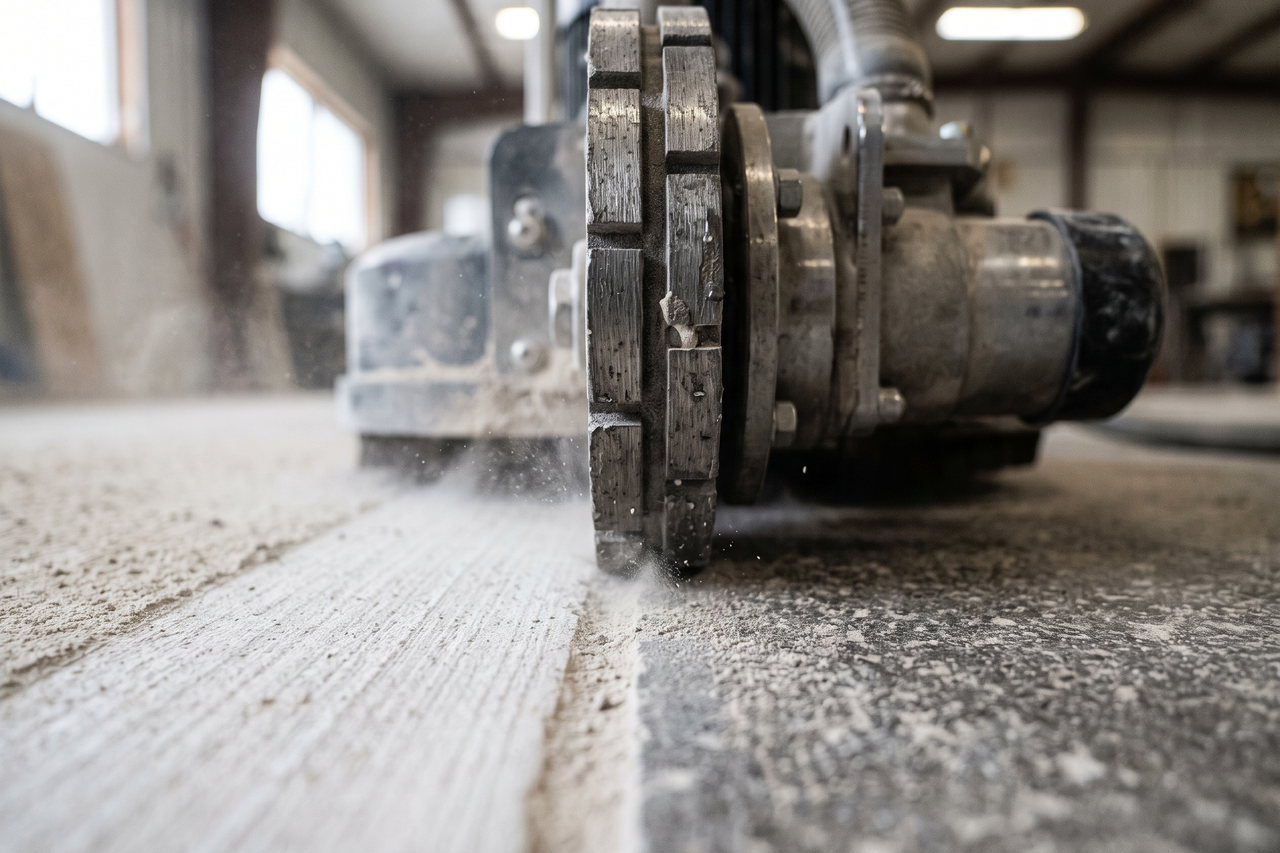
The floor is cleaned and then mechanically ground or shot-blasted to remove surface contaminants and create the open pore profile the coating needs to bond. On most slabs this step shouldn’t be skipped, and etching alone is generally not considered an adequate substitute.
02
Crack & Surface Repairs
Cracks, spalls, and other surface defects are filled and brought level before the coating goes down. Repairing damage at this stage means the finished floor is uniform and existing problems don’t telegraph through the coating over time. Learn more in our guide to epoxy floor repair.
03
Moisture Testing & Inspection
The contractor tests for moisture vapor transmission and inspects the overall slab condition. Moisture trapped beneath the coating is one of the most common causes of premature delamination, so this step informs whether the coating system selected is compatible with the floor’s actual condition.
How Does Grinding Improve Adhesion?
Concrete straight from the pour — or a floor that has been painted, sealed, or coated before — has a relatively smooth surface at the microscopic level. Epoxy and polyaspartic coatings need a slightly rough, open surface profile to form a mechanical bond. Without it, the coating sits on top of the slab rather than locking into it.
Mechanical grinding uses diamond tooling to remove the top layer of the concrete and expose the aggregate beneath. Shot-blasting achieves a similar result through a different method. Either way, the goal is the same: a clean, profiled surface that gives the coating material something to grip.
The depth of the profile depends on the coating system being applied and the condition of the existing slab. The contractor evaluates the floor and selects the appropriate preparation method before work begins.
Should Cracks Be Repaired First?
Yes — cracks and surface defects should be addressed during concrete preparation, before the coating is applied. Coating over an unrepaired crack does not stabilize the crack; it simply covers it temporarily. As the concrete continues to move with temperature and load, the crack can telegraph through the coating and cause premature failure along that line.
The contractor assesses each crack and defect individually. Fine surface cracks may be filled with a flexible epoxy filler. Larger or structural cracks warrant a closer look to understand their cause before any repair is attempted. In some cases, the scope of repair work affects the overall project plan.
For a detailed look at what repair evaluation involves, see our epoxy floor repair guide.
Why Is Moisture Testing Important?
Concrete is not waterproof. It holds and transmits moisture vapor from the ground beneath it, and that vapor has to go somewhere. When a coating is applied over concrete with elevated moisture vapor transmission, the vapor pressure can work between the coating and the slab — which can lead to bubbling, delamination or adhesion failure that may not show up until after installation.
Moisture testing gives the contractor the information needed to choose a coating system that is compatible with the floor’s actual moisture profile. Some systems are more tolerant of moisture vapor than others. Some floors benefit from a moisture-mitigation primer applied before the topcoat. The right approach depends on what the test reveals.
Skipping this step means making assumptions about the floor’s condition — and assumptions are where a lot of coating failures begin.
Can Epoxy Go Over Painted or Previously Coated Concrete?
Sometimes. The honest answer is that it depends on what is already on the floor, how well it is adhering, and whether the existing coating is compatible with the system being applied.
If a previous coating is failing — peeling, flaking, or showing delamination — it generally needs to be removed before a new coating can go down. Applying fresh epoxy over a failing layer does not fix the underlying adhesion problem; it adds another layer on top of it.
If a previous coating is fully bonded and in good condition, it may be possible to coat over it depending on the coating types involved. The contractor evaluates the existing surface during preparation and advises on the most appropriate approach. What is on the floor going into the project always affects what needs to happen before the new coating can be applied.
How Should You Prepare Your Garage Before the Contractor Arrives?
The preparation work — grinding, crack repair, moisture testing — is handled by the installer. But there are a few things that make the process smoother and help the contractor assess the floor accurately.
Garage prep checklist:
- Remove vehicles, tools, storage items, and anything else from the garage floor entirely — the contractor needs full access to the slab.
- Note any areas where the floor stays wet, shows white powder (efflorescence), or feels soft or hollow — these are signs of potential moisture or structural issues worth flagging.
- If the floor has been previously painted or coated, let the contractor know what product was used if you have that information.
- Ask the contractor what to expect regarding timing and when the floor will be ready for use — the installer explains the schedule before work begins.
For a full walk-through of what the installation process involves, see our epoxy floor installation guide.
Frequently Asked Questions About Concrete Preparation
How important is concrete preparation compared to the coating itself?
Poor preparation is often part of the problem when a coating fails, alongside moisture, coating selection and installation conditions. Even a high-quality coating has a harder time bonding to concrete that hasn’t been properly cleaned, profiled and repaired. Good prep gives the coating a better foundation for long-term performance.
Does all concrete need the same level of preparation?
No. The extent of preparation depends on the floor’s current condition, what is already on it, its moisture profile, and the coating system being applied. The contractor assesses the slab and determines the appropriate preparation scope before starting work.
What if my concrete has a lot of cracks?
Cracks are evaluated individually. Most surface cracks can be filled as part of preparation. Larger or more complex cracks may require a different approach, and the contractor will advise on the best path forward based on what the inspection reveals.
Can I just acid-etch instead of grind?
Acid etching was once a common substitute for mechanical grinding, but it is generally considered less effective for most modern coating systems. The profile it creates is typically shallower, and it can leave mineral residues if not thoroughly rinsed. The contractor will recommend the preparation method that suits the coating system and the floor’s condition.
How long does newly poured concrete need to cure before it can be coated?
Newly poured concrete generally needs roughly 28 days to cure before an epoxy or polyaspartic coating can be applied — this is a common guideline in the industry, not a universal rule. The actual timeline depends on the concrete mix, ambient conditions, and the coating system specified. The contractor confirms the readiness of the slab before preparation begins.
What happens if moisture is found during testing?
Finding elevated moisture does not necessarily mean the project cannot proceed, but it does affect product selection. The contractor reviews the test results and recommends a coating system or primer approach that addresses the moisture profile. In some situations, a moisture-mitigation step is added to the preparation process.
Ready to Get a Quote for Your Concrete Floor in Ottumwa, IA?
Good preparation starts with understanding what your specific floor needs. Connect with a flooring contractor who can assess the slab, outline the preparation process, and recommend the right coating system for your project.