
Epoxy Floor Repair
A damaged epoxy floor doesn’t always mean starting over. Cracks, chips, peeling sections, and worn areas can often be repaired — but what makes sense depends on the extent of the damage, what caused it, and how much of the original coating is still intact. A contractor evaluates the floor before recommending repair, recoating, or full replacement.

The Short Answer
Most epoxy floor damage falls into a few recognizable categories: cracks and chips, peeling or delamination, and surface wear. Each one has a different cause and a different set of options. A professional evaluation of the existing coating is the starting point — it determines whether repair is sufficient, whether the coating needs to be removed and replaced, or whether a fresh recoat over a still-bonded surface makes more sense.
Common Problems With Epoxy Floors
Most epoxy floor damage falls into a few recognizable categories, each with a different cause and a different set of options.
01
Cracks & Chips
Cracks in epoxy floors usually trace back to movement or damage in the concrete beneath, not the coating itself. Point-impact chips from dropped tools or heavy equipment are also common. Surface cracks and localized chips can often be filled and blended, though the underlying concrete condition is always evaluated first.
02
Peeling & Delamination
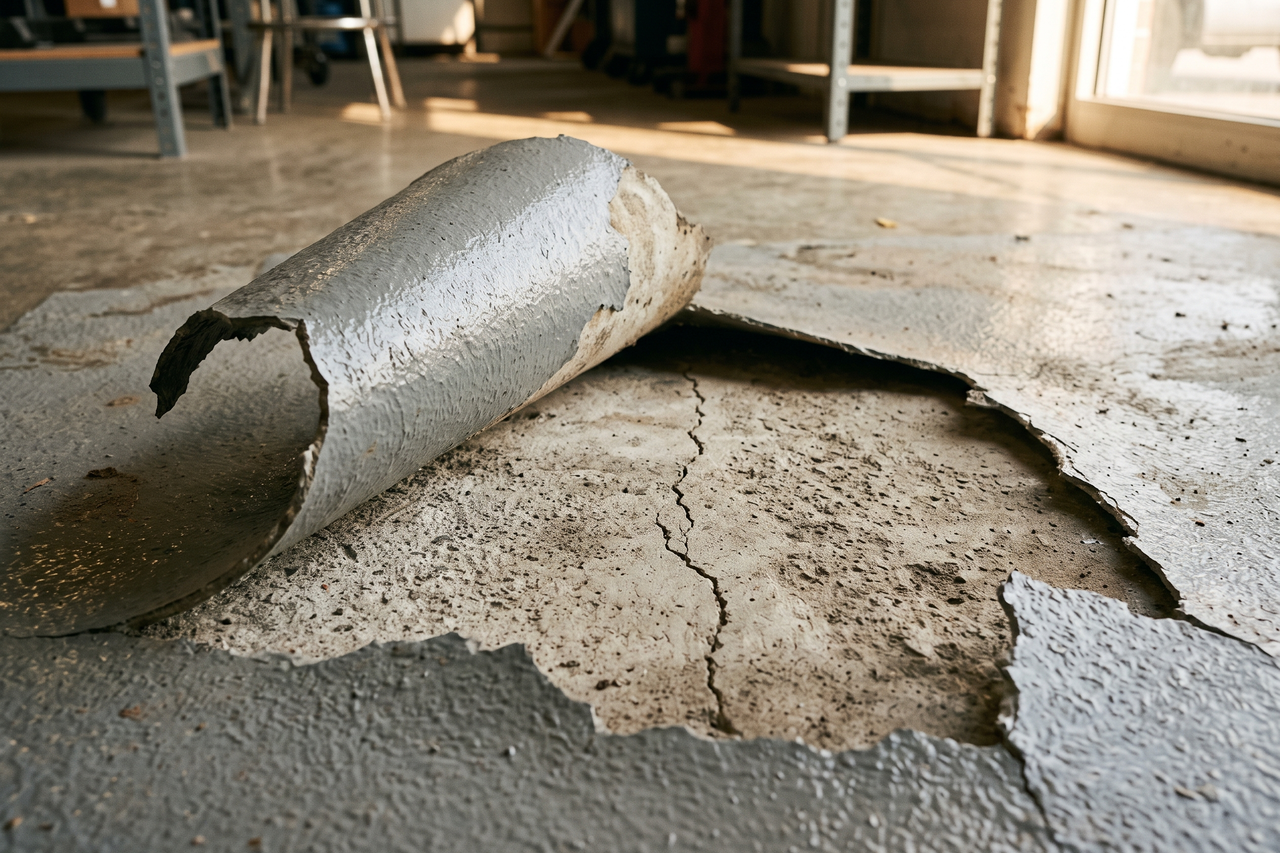
Peeling is one of the most visible signs of coating failure — and one of the most frustrating, because it tends to spread once it starts. Delamination happens when the bond between the coating and the concrete breaks down. The cause is often traced to preparation: moisture, a surface that wasn’t properly profiled, or a previous coating that wasn’t fully removed. Understanding why the coating is failing informs what the repair needs to accomplish.
03
Stains & Surface Wear
Chemical stains, tire marks, and general surface dulling from foot and vehicle traffic are different from structural failures. Sometimes worn or stained surface layers can be addressed with a fresh topcoat over an otherwise sound coating. The contractor assesses whether the existing coating is still bonded well enough to recoat, or whether it needs to come off first.
How Do Professionals Repair Peeling or Damaged Epoxy Floors?
The repair process begins with an assessment of the existing coating — not with product application. Before anything goes back down on the floor, the contractor evaluates how much of the coating is still adhering, what is causing the failure, and what the concrete looks like in the affected areas.
Peeling sections are removed completely. Any coating that lifts easily or sounds hollow when tapped indicates a bond failure that cannot simply be coated over. Once failing material is cleared away, the exposed concrete is prepared — cleaned, ground, and inspected — before any repair filler or new coating is applied. Applying new material over a poorly bonded surface just relocates the failure.
For larger areas of delamination, the scope of work may approach a full recoat rather than a spot repair. The contractor assesses the full extent of the failure before advising on the most appropriate path.
Proper preparation of the exposed concrete is an essential part of any epoxy floor repair. Learn more in our guide to concrete preparation for epoxy flooring.
Can an Epoxy Floor Be Repaired, or Does It Need to Be Replaced?
Both outcomes are possible, and the answer depends on the condition of the existing coating and what is causing the problem. Not every damaged floor needs to be stripped and redone from scratch — but not every floor is a good candidate for a spot repair or simple recoat, either.
A repair may be the right choice when the damage is localized — a section of peeling in one area, a cluster of chips near a workbench, or a crack that has been stable over time. If the rest of the coating is sound and well-bonded, repairing the affected area and optionally refreshing the surface can extend the life of the floor without a full installation.
A full removal and recoat makes more sense when the existing coating has widespread adhesion failure, when moisture was never properly addressed before the original installation, or when the floor’s appearance has degraded beyond what a surface treatment can restore.
The decision isn’t always obvious from looking at the floor. A contractor who can probe, test, and evaluate the coating’s actual bond strength gives you a more reliable picture than a visual inspection alone. When a full recoat or new installation is the better solution, see our epoxy floor installation guide for a walk-through of what that process involves.
How Much Does Epoxy Floor Repair Cost?
Repair cost varies considerably based on the type and extent of the damage, how much of the existing coating needs to be removed, the condition of the underlying concrete, and the scope of surface preparation required. A spot crack fill on an otherwise sound floor is a very different project from stripping and recoating a floor with widespread delamination.
There is no standard repair price that applies across different floor conditions and situations. The contractor assesses the specific floor and provides an estimate based on what the job actually requires. No prices for repair work are listed here, because the range is too wide to be useful without knowing the floor.
What Causes Epoxy Floors to Fail, and How Can You Prevent It?
Understanding why coatings fail is useful whether you are dealing with a current problem or planning a new installation. Most failures trace back to one of a handful of root causes.
Improper Concrete Preparation
Poor preparation is often part of the problem when an epoxy floor fails prematurely. A surface that wasn’t properly ground or profiled, a previous coating that wasn’t fully removed, or contaminants left on the slab can all prevent the coating from forming a true mechanical bond. The coating may look fine at first and begin lifting later as the bond works loose.
This is why concrete preparation is treated as its own step, not a shortcut. See our concrete preparation guide for a full explanation of what that process involves.
Excess Moisture
Moisture vapor transmitted through the slab is one of the most common and least visible causes of coating failure. The vapor works between the coating and the concrete, breaking down the bond from below. A coating applied over concrete with unaddressed moisture issues may begin to bubble, blister, or peel as moisture pressure builds beneath it.
Moisture testing before installation — and choosing a coating system compatible with the floor’s moisture profile — is how this cause of failure is addressed. Contractors who skip testing are making assumptions about the floor that may not hold.
Heavy Impacts and Chemical Exposure
Epoxy coatings are durable, but they have limits. Heavy point impacts from dropped equipment, prolonged exposure to harsh chemicals outside the coating’s tolerance range, and abrasive wear from certain traffic patterns can all degrade a coating over time. The right coating system for a given environment — whether a garage, a basement, or a commercial facility — depends on the actual conditions the floor will face. Suitability depends on the system selected and the facility’s real-world conditions; no coating is universally appropriate for every use.
Improper Installation or Curing
Even well-prepared concrete can result in a failing floor if the coating is applied incorrectly — wrong mix ratios, application outside the product’s temperature and humidity specifications, or insufficient time between coats. Curing conditions during and after installation also affect how the coating performs. The installer explains the expected curing schedule before work begins, along with any conditions that need to be maintained during that period. When the root cause of a failure points to installation, a new application may be needed. Our epoxy floor installation guide walks through what a professional installation process looks like.
Can Garage, Basement, and Commercial Epoxy Floors Be Repaired?
The short answer is that repair is evaluated case by case for all three settings. The use of the space and the nature of the damage both factor into what makes sense.
Garage Floor Repair
Garage floors take a lot of abuse — vehicle traffic, road chemicals, point impacts, and temperature cycling. Chips, cracks, and peeling sections are common. Localized damage can often be repaired when the rest of the coating is holding well. When tire marks, chemical staining, or widespread delamination are the issue, the contractor evaluates whether a full recoat is the better path. See our garage floor coatings page for more on what a sound garage floor coating involves.
Whether scheduling accommodates a phased approach — for example, repairing one bay at a time in an active garage — depends on the project scope and the contractor. That conversation happens during the estimate.
Basement Floor Repair
Basement floors present unique considerations because moisture is more likely to be a factor. If a basement coating failed due to moisture, addressing the moisture issue is part of the repair plan — not just removing and reapplying the coating. Coating over an active moisture problem will produce the same failure. The contractor assesses both the coating condition and the moisture situation before recommending a repair approach. Our basement floor coatings page covers what a well-executed basement installation involves.
Commercial Epoxy Floor Repair
Commercial floors carry heavier and more varied traffic than residential floors, and a failed coating can affect safety and operations. Localized repairs may be possible when the affected area is limited and the rest of the coating is sound. Large-scale delamination or a widespread adhesion failure typically warrants a more comprehensive evaluation. For facilities that cannot go out of service, project sequencing and timing are discussed during the estimate — those details depend on the project and the contractor. See our commercial epoxy flooring page for context on what commercial-grade coating projects involve.
Frequently Asked Questions About Epoxy Floor Repair
Can I repair a peeling epoxy floor myself?
DIY patch kits are available, but they address the symptom rather than the cause. If the coating is peeling because of a bond failure — whether from moisture, poor prep, or an incompatible coating — patching over it without fixing the underlying problem tends to result in the patch failing too. A professional evaluation identifies the cause before repair begins.
How do I know if my floor needs repair or full replacement?
The key question is how much of the existing coating is still bonded. A contractor can probe and test the coating across the floor to get a real picture of how widespread the adhesion failure is. If it is localized, repair may be appropriate. If it is widespread, a full removal and recoat is usually the more reliable solution.
How long does an epoxy floor repair take?
It depends on the size and nature of the damage, the scope of surface preparation required, and the coating system being applied. The installer explains the expected timeline before work begins — including when the floor will be ready for foot traffic and vehicle use.
Will a repaired section match the rest of the floor?
Color and finish matching depends on the age and condition of the existing coating, the specific product used originally, and how much of the floor is being repaired. The contractor advises on what a realistic match looks like given the specific situation. In some cases, the most consistent result comes from recoating the entire floor rather than patching.
Is moisture always the cause of epoxy peeling?
Moisture is one of the most common causes, but not the only one. Poor concrete preparation, coating over an incompatible surface, incorrect mixing or application, and insufficient curing time can all lead to adhesion failures. The contractor’s assessment identifies the most likely cause based on how and where the failure is occurring.
Does an epoxy repair come with a warranty?
Warranty terms — if offered — are set by the contractor performing the work and depend on the scope and method of repair. Any warranty information should be discussed and confirmed directly with the contractor before work begins.
Ready to Evaluate Your Floor in Ottumwa, IA?
If your epoxy floor is cracking, peeling, or showing signs of wear, connecting with a flooring contractor is the right first step. The contractor assesses the existing coating, identifies what caused the problem, and recommends the repair or replacement approach that makes the most sense for your floor.